
Struggling with tight spaces where a swinging door is impossible? You need a solution that saves floor area. A pocket door is the sleek, space-saving answer you’ve been looking for.
You can install a pocket door in most interior, non-load-bearing walls. They are ideal for bathrooms, closets, home offices, and any area where a traditional swinging door is impractical. The key is ensuring the wall is wide enough to hold the door and free of obstructions.

As a manufacturer of door hardware systems at opensliding, I talk to clients like Jacky, a purchasing manager in Canada, all the time. They need reliable, high-quality hardware for their projects. They often ask about the practicalities of pocket doors because while the space-saving benefit is huge, the installation details are critical. Let’s break down the most common questions I get, so you can make an informed decision for your next project.
Can a pocket door go in any wall?
Worried your project’s wall isn’t suitable for a pocket door? You might fear that it’s too thin or has hidden pipes. The good news is that most interior walls can work with the right planning and hardware.
A pocket door can be installed in most standard 2×4 or 2×6 stud interior walls. It cannot, however, go into a load-bearing wall without significant structural work approved by an engineer. You must also check for plumbing, electrical wiring, and HVAC ducts before starting.
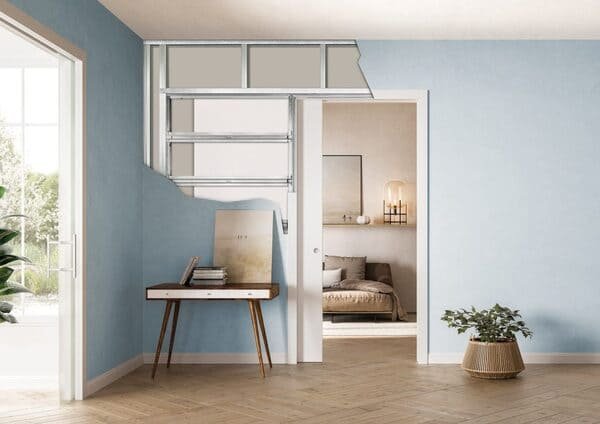
When a client asks me this, I tell them to think about three main things: wall thickness, structural role, and hidden obstacles. Getting this right from the start saves a massive amount of time and money.
Wall Thickness and Structure
Most modern interior walls are built with 2×4 studs. Our pocket door kits at opensliding are designed specifically for this standard. A standard 1-3/8" thick door fits perfectly. If you have thicker 2×6 walls, that’s even better, as it provides more stability and space. However, if a project requires a thicker door, the wall may need to be built out to accommodate it.
Load-Bearing vs. Non-Load-Bearing1
This is the most critical factor. A non-load-bearing wall simply divides a space. A load-bearing wall supports the weight of the structure above it. You cannot simply cut out the studs in a load-bearing wall to install a pocket door frame. Doing so could compromise the building’s integrity. To use a load-bearing wall, you must hire a structural engineer to design a proper header to transfer the load safely.
Hidden Obstructions2
Before cutting into any wall, you have to know what’s inside.
| Wall Type | Suitable for Pocket Door? | Key Considerations |
|---|---|---|
| Standard 2×4 Wall | Yes | This is the most common scenario. Our kits are optimized for this. |
| Standard 2×6 Wall | Yes (Ideal) | Offers more stability and installation is generally easier. |
| Load-Bearing Wall | No (Without Engineer) | Requires a structural header to carry the load. Do not attempt otherwise. |
| Wall with Utilities | Maybe | Plumbing, electrical, and HVAC must be rerouted by a professional. This adds significant cost. |
How do you install a pocket door in an existing wall?
The idea of cutting into a finished wall feels daunting. You’re afraid of messing up the drywall and frame. But if you follow a clear process, it’s a very manageable project for a professional contractor.
To install a pocket door in an existing wall, you must remove the drywall from one or both sides. Then, you’ll remove the existing studs, frame a new opening with a header, assemble the pocket door kit inside, and finally, finish with new drywall.

At my factory, we design our pocket door systems for straightforward installation, but precision is everything. A poorly installed track or frame will lead to a door that sticks, wobbles, or falls off the track. We provide detailed instructions with all our kits because we want the end user to have a perfectly functioning door.
Here is a simplified breakdown of the installation process:
1. Site Inspection and Prep
First, use a stud finder and, if possible, an inspection camera to check for plumbing, wiring, or ducts inside the wall cavity. Shut off power and water to the area just in case. Mark the outline of the new rough opening, which needs to be slightly more than double the width of the door.
2. Demolition
Carefully cut and remove the drywall within the marked area. You’ll need to do this on at least one side, but removing it from both sides often makes the next steps easier. Pull out any insulation.
3. Framing the Opening
This is the most crucial part. Cut and remove the existing studs in the opening. You will then install a new header across the top of the opening to provide support. After that, you assemble the pocket door hardware kit3, which includes the track and split studs, and secure it within the new opening. The track must be perfectly level.
4. Hanging the Door
Once the frame is secure, you can hang the door on the rollers. Slide it back and forth to test for smooth operation. Make any necessary height and alignment adjustments now. This is where the quality of the rollers and track system really shows. Our heavy-duty rollers4 ensure years of silent, smooth gliding.
5. Finishing
Once you are happy with the door’s movement, you can install the new drywall over the frame. Then, it’s time for taping, mudding, sanding, and painting to make the wall look seamless again.
Can I install a pocket door without removing drywall?
You want the space-saving benefits but dread the thought of a dusty, messy demolition. You hope there’s a way to install a pocket door without tearing down your walls. Unfortunately, this is not a realistic option.
No, you cannot install a true, recessed pocket door without removing the drywall. The entire installation process relies on accessing the wall’s internal framing to remove studs and secure the new pocket door frame and track system inside the wall cavity.
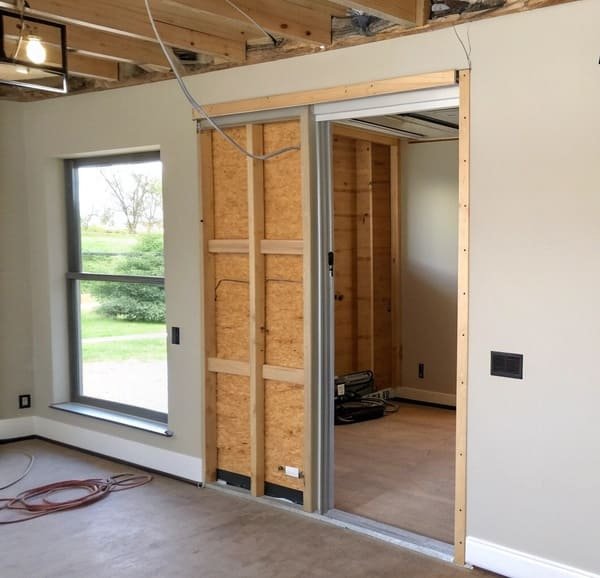
I sometimes get this question from distributors whose customers are looking for the easiest possible solution. I always explain that the "pocket" in a pocket door means the door slides into a pocket inside the wall. Without creating that pocket, it simply isn’t a pocket door.
Why Drywall Removal is Non-Negotiable
A pocket door5 isn’t just a door on a track; it’s a complete system. This system includes a steel-reinforced frame (the pocket) that replaces the wooden studs you remove from the wall. This frame provides the new structure for the wall and a cavity for the door to slide into. The overhead track that the door hangs from is an integral part of this frame. To properly remove the old studs, install this new frame, and ensure everything is level and plumb, you absolutely must have the wall opened up. Trying to do this through a small hole would be impossible and would result in a door that doesn’t work.
The Best Alternative: Wall-Mounted Sliding Doors
If a customer is completely against removing drywall, the best alternative is a wall-mounted sliding door6, often called a barn door. Instead of sliding into the wall, the door slides on a track mounted on the outside of the wall. This is a much less invasive installation that still saves floor space compared to a swinging door. At opensliding, we manufacture a wide range of barn door hardware systems as well, from rustic to modern styles, giving our clients great options for every situation.
Which is better, a pocket door or a sliding door?
You’re trying to decide on a space-saving door. With both pocket doors and sliding barn doors available, you’re not sure which is the clear winner for your project’s specific needs and aesthetic goals.
A pocket door is better for a clean, minimalist look because it disappears completely into the wall. A sliding barn door is better for easier installation and for making a decorative statement, as the hardware and door remain visible. The choice depends on looks and budget.

As a supplier for both systems, I see my clients, from furniture factories to construction contractors, weigh these options constantly. There is no single "better" choice; the right door depends entirely on the project’s priorities. I tell them to compare the two across several key areas.
Here is a table I often share with clients to help them decide:
| Feature | Pocket Door | Sliding Barn Door |
|---|---|---|
| Aesthetics | Minimalist, clean, hidden. The door disappears for an open feel. | Statement piece. The door and hardware are visible design elements. |
| Space Use | Excellent. Saves floor space and leaves the adjacent wall free for art or furniture. | Good. Saves floor space but requires a clear section of wall for the door to slide over. |
| Installation | Complex. Requires removing drywall and modifying wall framing. Best for new builds or major remodels. | Simple. The track is mounted directly onto the wall surface. Can be a DIY project. |
| Cost | Higher initial cost due to more complex labor and the frame kit. | Generally lower cost, as installation is much simpler and faster. |
| Privacy & Sealing | Better. Can be fitted with jambs and seals for a tighter closure, improving sound and light blocking. | Poorer. There is typically a gap between the door and the wall, offering less privacy. |
For a project demanding a seamless look, like a modern master bathroom or a minimalist office, the pocket door is unmatched. For a project where a client wants to add character, like a farmhouse kitchen pantry or a rustic loft divider, the barn door is the perfect fit. Since opensliding produces top-tier hardware for both, we can support whatever direction your project takes.
Conclusion
Pocket doors are a fantastic, elegant way to save space. Successful installation depends on careful planning, understanding wall limitations, and using high-quality hardware for a smooth, lasting result.
Understanding this distinction is crucial for safe renovations. Explore this link to learn more about structural integrity. ↩
Knowing about hidden obstructions can save you from costly mistakes. Check this resource for essential insights before starting your project. ↩
Understanding the components of a pocket door hardware kit is essential for a successful installation, ensuring you have everything needed for a smooth operation. ↩
Exploring the advantages of heavy-duty rollers can help you choose the best option for durability and performance in your pocket door installation. ↩
Understanding pocket doors can help you appreciate their functionality and design, making your renovation decisions easier. ↩
Exploring the advantages of wall-mounted sliding doors can provide you with alternative solutions that save space and enhance your home’s aesthetics. ↩