
Struggling with drawers that stick, squeak, or slam shut? This constant friction can damage your furniture and cause frustration. The right slide rail roller ensures smooth, quiet operation.
The main types are ball-bearing and roller-bearing slides. Ball-bearing slides use steel balls for very smooth motion, ideal for quality furniture. Roller-bearing slides use simple nylon wheels, offering a basic and economical solution for lighter drawers. Each has specific uses depending on the load.
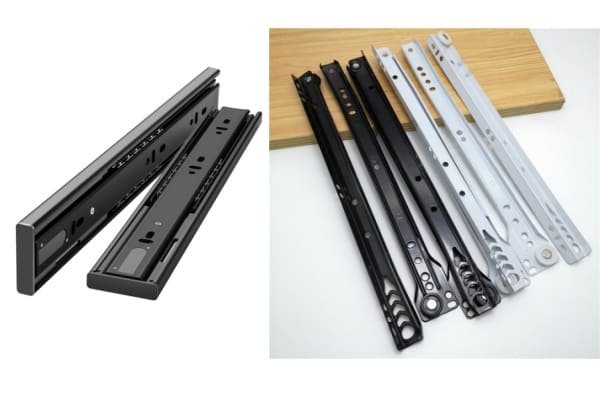
Choosing the right one seems simple, but there is more to it than you think. The weight of the drawer, the space you have, and how you plan to mount it all matter. As a factory owner, I’ve seen how these small details make a big difference in the final product’s quality and longevity. Let’s break it down further to help you choose the perfect fit for your project and avoid costly mistakes.
What are the different types of drawer glides?
Confused by the different terms like "drawer glides" and "drawer slides"? Choosing the wrong one can lead to wobbly drawers or a system that fails under its load.
Drawer glides, also known as drawer slides, mainly come in three types: roller slides, ball-bearing slides, and under-mount slides. Roller slides are basic and economical. Ball-bearing slides offer smoother action. Under-mount slides are hidden, providing a clean, modern look and smooth performance.
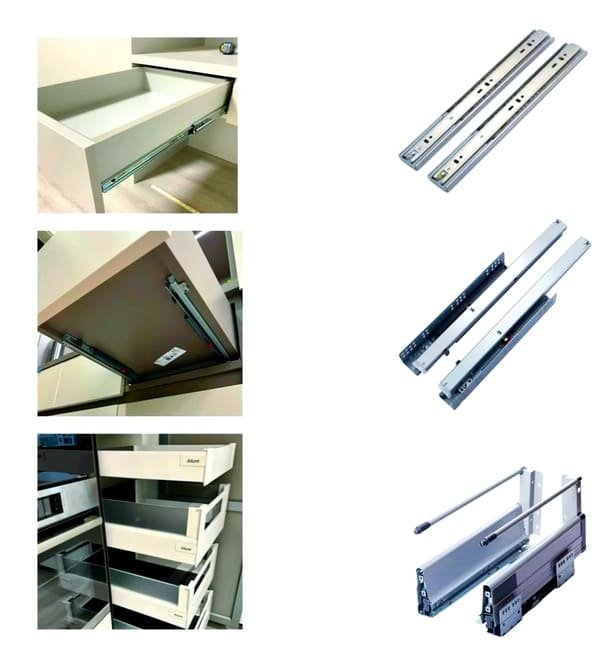
In my years of manufacturing hardware at opensliding, I’ve worked with countless purchasing managers like Jacky who need the best value for their projects. Understanding these core types is the first step. Let’s look at them more closely.
A Closer Look at Drawer Glide Types
Each type of glide serves a different purpose, balancing cost, performance, and aesthetics. Choosing correctly is critical for the end-user’s satisfaction.
| Glide Type | Best For | Key Feature | Common Application |
|---|---|---|---|
| Roller Slides | Budget-conscious projects, light loads | Two rollers per side, economical | Basic office furniture, utility cabinets |
| Ball-Bearing Slides1 | High-quality furniture, heavy loads | Steel ball bearings for smooth action | Kitchen cabinets, bedroom dressers, tool chests |
| Under-Mount Slides2 | Premium, high-end cabinetry | Hidden mechanism, often with soft-close | Custom kitchens, luxury furniture |
At my factory, we’ve found that ball-bearing slides offer the best balance of price and performance for most applications. They provide that feeling of quality that customers notice. Under-mount slides are the top choice for our clients building high-end, bespoke furniture where aesthetics are just as important as function.
How many types of rails are there?
Feeling overwhelmed by all the rail options available for your projects? Picking the wrong rail system can result in poor performance, instability, or even complete failure over time.
For cabinets and furniture, rails are mainly categorized as basic slides and telescopic slides. Basic slides, like roller slides, have a simple in-and-out motion. Telescopic slides, such as ball-bearing slides, have multiple sections that extend further, often allowing full drawer access.
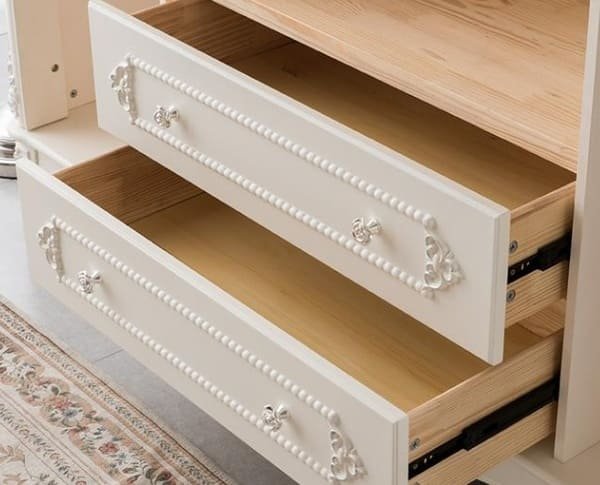
When we talk about "rails" in the hardware world, we are usually talking about the structure of the slide. It’s not just about the roller mechanism but how the entire assembly moves. The difference between a basic rail and a telescopic one directly impacts how useful the drawer is.
Understanding Rail Structures
A rail’s structure determines its extension, which is how far the drawer can open. This is a critical detail for functionality, especially in kitchens or workshops where you need to access the entire drawer.
Basic Slide Rails
These are the simplest form. A single moving member slides along a stationary track. This design is often called a ¾ extension slide because you can only access about 75% of the drawer’s depth. They are straightforward to make and install, which is why you see them on entry-level furniture. Their limitation is clear: the back of the drawer is always hard to reach.
Telescopic Rails
This is where things get more advanced. Telescopic rails have three or more members that slide past one another. Think of a telescope extending. This design allows for what we call "full extension3," meaning the entire drawer box clears the cabinet opening. You get full access to everything inside. As manufacturers, we build these with precision ball bearings to handle the movement smoothly, even with heavy loads. This is the standard for quality cabinetry today.
What are three different mounts for drawer slides?
Worried about installing drawer slides correctly? The mounting style you choose affects both the installation process and how the drawer functions. Picking the wrong one can be a costly mistake.
The three main mounting options for drawer slides are side-mount, center-mount, and under-mount. Side-mount is the most common and supports heavy loads. Center-mount is simpler but supports less weight. Under-mount is hidden from view for a premium, clean aesthetic.
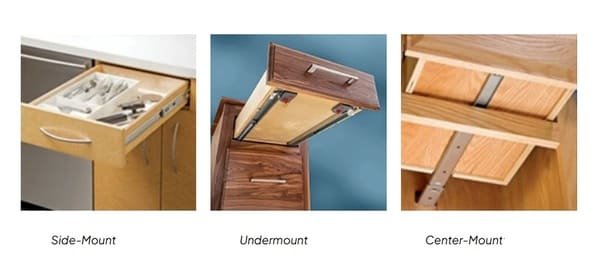
The way a slide attaches to the cabinet and drawer is just as important as the slide itself. I had a client in Canada who chose a center-mount for heavy kitchen drawers full of pots and pans. They failed within a year because the mount wasn’t designed for that weight. We helped them switch to a heavy-duty side-mount system, and the problem was solved immediately. This is why understanding mounts is so important.
Choosing Your Mounting Style
Let’s break down these three mounting styles to see where each one shines.
Side-Mount Slides4
These are the workhorses of the industry. They attach to the side of the drawer box and the inside wall of the cabinet. Because they come in pairs, they offer excellent stability and can handle significant weight, which is why they are the go-to for kitchens, office furniture, and workshops. They require precise spacing between the drawer and cabinet opening, but their durability is unmatched. Most ball-bearing slides use this mounting style.Center-Mount Slides
This style uses a single slide mounted under the center of the drawer. Installation can be simpler than a side-mount because you don’t need to align a pair of slides. However, their main drawback is a much lower weight capacity. They are best suited for very light-duty applications like a small desk drawer for pens or a jewelry box tray.Under-Mount Slides5
These offer the cleanest look. The slides mount to the sides of the cabinet and connect to locking devices on the underside of the drawer box itself. When you open the drawer, the hardware is completely hidden. This creates a high-end, professional look. They offer very smooth performance, often include soft-close features, and can support a good amount of weight. Their main downside is a higher cost and a more complex installation that requires a specific type of drawer box.
What are the different types of linear rails?
Do you need precise, smooth movement for something more demanding than just a drawer? Using the wrong type of linear rail for industrial or custom applications can cause binding, excess wear, or failure.
The two most common types of linear rails we see in furniture and architectural hardware are roller-bearing and ball-bearing slides. Roller-bearing types use cylindrical rollers for high load capacity. Ball-bearing types use small steel balls for extremely smooth, low-friction precision movement.
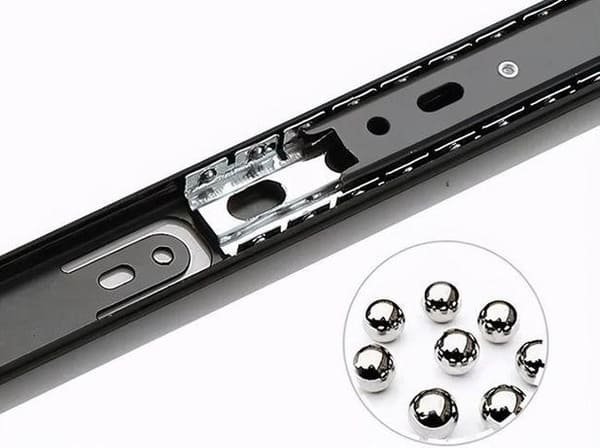
When we move beyond standard cabinets into larger-scale systems—like partition room doors, heavy-duty storage, or automated machinery—we start talking about linear rails. These are engineered for high performance. The core technology is similar to drawer slides but scaled up for greater loads and precision. At opensliding, we produce heavy-duty systems using these principles for everything from large wardrobe doors to industrial partitions. The choice between rollers and balls becomes critical.
Linear Rails: Ball vs. Roller Bearings
The decision comes down to a trade-off between load capacity and smoothness.
| Feature | Ball-Bearing Linear Rail | Roller-Bearing Linear Rail |
|---|---|---|
| Contact Point | Small point of contact | Line of contact |
| Load Capacity6 | Good | Excellent / Very High |
| Smoothness7 | Exceptionally smooth, low friction | Smooth, but higher friction |
| Rigidity | Good | Excellent |
| Best For | High-speed, high-precision, smooth movement | Heavy loads, high rigidity, industrial use |
Ball-Bearing Linear Rails: These work by having recirculating ball bearings in a block that glides along a rail. The small contact point of each ball creates incredibly low friction. This makes them perfect for applications where effortless motion is key, like in smart furniture, home lighting systems, or premium wardrobe doors that need to glide open with a light touch.
Roller-Bearing Linear Rails: Instead of balls, these use small cylinders (rollers). The roller creates a line of contact with the rail, which distributes the load over a larger area. This gives them a much higher load capacity and greater rigidity than ball bearings. We recommend these for our B2B clients building heavy-duty pantry pull-outs, movable walls, or commercial storage units where strength is the top priority.
Conclusion
Choosing the right slide rail involves matching the type, mount, and material to your specific load and application. This simple step ensures long-lasting, smooth, and reliable performance in your final product.
Explore this link to understand why Ball-Bearing Slides are ideal for heavy loads and high-quality furniture, enhancing durability and performance. ↩
Discover how Under-Mount Slides can elevate the look of your cabinetry while providing functionality, perfect for luxury furniture. ↩
Understanding full extension can enhance your knowledge of drawer functionality and improve your furniture choices. ↩
Explore this link to understand why Side-Mount Slides are preferred for their stability and weight capacity in various applications. ↩
Discover how Under-Mount Slides can provide a sleek, professional look while ensuring smooth performance and functionality. ↩
Understanding load capacity is crucial for selecting the right linear rail for your application, ensuring safety and efficiency. ↩
Exploring smoothness differences helps in choosing the best rail for applications requiring precision and minimal friction. ↩