
Problem: You received a great quote from China, but now you’re worried about hidden tax costs. Are they included, or will you face a surprise bill later on?
No, a quotation from a Chinese supplier for a glass sliding door pulley system almost never includes your country’s import taxes or duties. These are separate charges you will pay to your government when the goods arrive. The quote you receive from me covers the product cost.
I’ve been exporting hardware like sliding door systems for many years, and one of the biggest points of confusion for new buyers is understanding the total cost. The number on my quotation is just the starting point. It is very important to understand what is included and what is not. Let’s break down all the parts so you can calculate your final price accurately and avoid any surprises. This will help you see the true cost of landing the products in your warehouse.
Are procurement duties included or excluded?
Problem: You see a product price but are unsure about import duties. Agitating: Ignoring these duties can completely destroy your budget and your expected profit margins. Solution: You must understand they are excluded.
Procurement duties, also known as import tariffs, are always excluded from a standard Chinese supplier’s quotation. These taxes are determined and collected by your own country’s customs authority. As the importer, you are responsible for paying them, usually through a customs broker.
When you import goods into your country, your government charges a tax. This is the import duty or tariff. I, as a manufacturer in China, cannot include this in my price for a very simple reason: these taxes are different for every country. A glass sliding door pulley system sent to Canada will have a different duty rate than one sent to the USA, Australia, or Italy. These rates can also change based on international trade agreements. Furthermore, the duty is often calculated on the total value of the goods plus the cost of shipping and insurance. Since you, the buyer, often arrange your own shipping, I don’t know the final value that your customs office will use. This makes it impossible for me to quote it for you. You are the "importer of record," which means you are legally responsible for these costs.
Here is a simple breakdown of the costs:
| Cost Component | Who You Pay | Included in my Quote? |
|---|---|---|
| Product Cost | Your Supplier (opensliding) | Yes |
| China-Side Logistics | Your Supplier (opensliding) | Depends on price term (e.g., Yes for FOB) |
| International Shipping | Your Freight Forwarder | No (Unless you request CIF) |
| Import Duties & Taxes | Your Country’s Customs | No |
| Customs Brokerage Fee | Your Customs Broker | No |
| Local Delivery | Your Local Trucking Company | No |
Can I request CIF, FOB, or EXW pricing?
Problem: You see trade terms like FOB, CIF, and EXW and feel confused. Agitating: Choosing the wrong one can lead to unexpected costs and logistical headaches. Solution: Let’s define them simply.
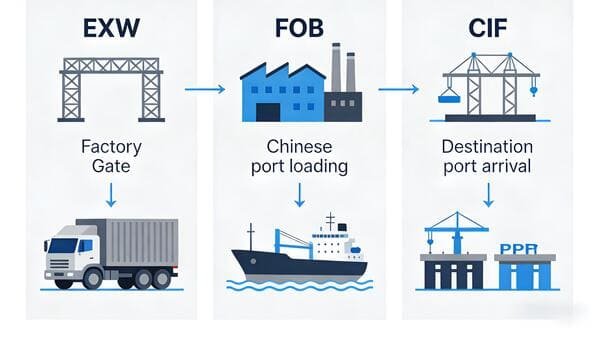
Yes, you can and should always request pricing based on different Incoterms like EXW, FOB, or CIF. These terms clearly define who is responsible for shipping costs and risk. FOB is most common, but at opensliding, we are happy to provide quotes for any term you need.

Incoterms are standard international rules that define the responsibilities of sellers and buyers. Understanding them is key to managing your costs. We can work with any term, but these are the three most common you will encounter.
EXW (Ex Works)
This is the "factory gate" price. My responsibility ends when the goods are packaged and ready for you to pick up from my factory here in China. You or your agent must handle everything else. This includes arranging trucking in China, handling export customs clearance, paying for sea or air freight, insurance, and all import procedures in your country. This option gives you the most control over logistics but also requires the most work on your part.
FOB (Free On Board)1
This is the most popular option for my customers. The FOB price includes the product cost plus all the expenses to get it loaded onto the ship at a Chinese port (like Shanghai or Ningbo). My responsibility ends once the goods are on the vessel. From that point on, you are responsible for paying the ocean freight, insurance, and all costs in your country.
CIF (Cost, Insurance, and Freight)2
With CIF, my quoted price includes the product cost, marine insurance, and the shipping cost to your destination port. This is more convenient as I handle the shipping booking. However, my responsibility ends when the goods arrive at your country’s port. You still have to manage customs clearance, pay duties, and arrange for delivery from the port to your warehouse.
How do I calculate total landed cost?
Problem: You only know the product’s FOB price. Agitating: You can’t determine your true profit margin without knowing all the other hidden expenses. Solution: You need a clear formula.
To calculate your total landed cost, you must add the supplier’s price (product cost + shipping to port) to your international freight, insurance, customs duties, brokerage fees, and local delivery charges. This final number is the true cost per unit.
Calculating the total landed cost is the most important step for understanding your real cost and profitability. It’s the only way to compare a Chinese supplier’s price with a domestic supplier’s price fairly. You need to add up all the costs to get the product from my factory door to your warehouse door. The best way to do this is to work with a customs broker or a freight forwarder in your country. They are experts in this. Just give them the product information (HS code, weight, volume, and value from my proforma invoice), and they can give you a detailed quote.
Here is a step-by-step formula to guide you:
- Product Cost (from my FOB Quote): This is the base price for the glass sliding door pulley systems.
- International Freight: Get a quote from a freight forwarder for shipping from the FOB port in China to your nearest port.
- Insurance: This is usually about 0.5% of the invoice value.
- Customs Duty: Your broker will calculate this using the product’s HS Code.
- Other Taxes (e.g., GST, VAT): Your government may apply other sales taxes.
- Brokerage & Port Fees: Your customs broker will charge a fee for their service, and there are port handling charges.
- Inland Transportation: The cost to truck the container from the port to your final destination.
Total Landed Cost = (Step 1 + 2 + 3 + 4 + 5 + 6 + 7)
Divide this total by the number of units to get your true cost per pulley system.
Can suppliers provide tax certificates for customs clearance?
Problem: Your customs broker is asking for specific documents. Agitating: Without the right paperwork, your shipment could be delayed, costing you time and money. Solution: Ask your supplier for them.
Yes, we can and will provide all necessary documents for your customs clearance. This typically includes the Commercial Invoice, Packing List, and Bill of Lading. For some countries, we can also provide a Certificate of Origin to potentially lower your duty rates.
Smooth customs clearance depends entirely on having the correct documentation. As an experienced factory and exporter, we understand this process very well. We work with our customers to ensure all paperwork is accurate and complete before the shipment even leaves China.
Key Documents We Provide:
- Commercial Invoice3: This lists the buyer, seller, product descriptions, quantities, unit prices, and total value. Your customs office uses this to determine the duties you owe.
- Packing List: This document details the contents of each carton, including weights and dimensions. It’s essential for customs to verify the shipment’s contents.
- Bill of Lading (B/L): This is the contract between the shipper and the carrier. It acts as a receipt for the goods and a title document needed to claim the shipment at the destination port.
Special Certificates:
For certain countries that have free trade agreements with China, we can also apply for a Certificate of Origin (CO)4. This official document certifies that the goods were manufactured in China. Presenting a CO to your customs authority can sometimes lead to reduced or even zero import tariffs, which can save you a lot of money. If this is available for your country, we will let you know and help prepare the document. Just ask me or my team, and we will confirm what we can provide.
Conclusion
In short, my quotes don’t include your import taxes. You must calculate duties and shipping to find your true landed cost. I can provide the documents you need for clearance.
Exploring this link will provide insights into the benefits of FOB shipping, helping you make informed logistics decisions. ↩
This resource will clarify how CIF shipping operates, ensuring you understand the costs and responsibilities involved. ↩
Exploring the significance of a Commercial Invoice can enhance your knowledge of customs requirements and duties. ↩
Understanding the Certificate of Origin can help you save on import tariffs and streamline customs processes. ↩