
Struggling with unclear warranties from suppliers? This uncertainty can risk your project’s success and budget. Let’s clarify what you should expect and demand from your hardware partner.
The warranty for a glass sliding door pulley system from China typically ranges from 1 to 10 years. However, there is no single standard. The warranty period is always defined by the specific contract you sign with the manufacturer, so it is crucial to review it carefully.
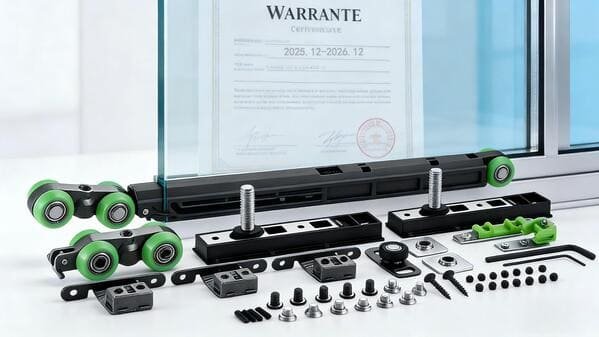
Understanding the warranty on parts you buy from China is very important. It’s not just a piece of paper; it’s a promise about the quality and life of the product. As An Industry Professionals In Sliding Door Pulleys System, I see many buyers get confused by this. They think there is one rule for all suppliers, but that is not true. The warranty depends on the factory, the product quality, and the deal you make. In this post, I will break down the common questions I get from buyers like you. This will help you protect your business and get the best value. Let’s look deeper into what these warranties really mean for you.
Are there extended warranty options?
Worried a standard warranty is too short for your project’s needs? This could make you lose out on premium clients who demand longer guarantees. The solution is simple: discuss extended options.
Yes, many Chinese manufacturers, including my factory, opensliding, offer extended warranty options. These are often available for an additional cost or for larger volume orders. You must negotiate and confirm these terms before you finalize your purchasing contract. It is not an automatic option.

An extended warranty gives you and your customers extra peace of mind. But it is a business decision for both you and the supplier. At my factory, we are open to discussing longer warranties because we are confident in our product quality. When a buyer asks for this, we look at several factors. We consider the specific product, its intended use, and the order size. A larger, consistent order makes it easier for us to offer better terms. Think of it as a partnership. If you commit to us, we can offer you more security in return.
How to Secure an Extended Warranty
You need to be proactive to get a longer warranty. Don’t wait until the last minute.
- Start Early: Bring up the topic of an extended warranty during your first talks with the supplier.
- Be Specific: Explain why you need a longer warranty. Tell us about your project requirements or market demands.
- Get It in Writing: Make sure the extended warranty period is clearly stated in your final contract.
| Factor | Impact on Extended Warranty |
|---|---|
| Order Volume | Larger orders often qualify for better warranty terms. |
| Product Grade | Higher-quality, more expensive systems can support longer warranties. |
| Supplier Relationship | Long-term, loyal customers may receive more favorable options. |
| Additional Cost | Be prepared to pay a small premium for the extra coverage. |
Does the warranty cover all components?
You might think a warranty covers every single part of the system. A small, uncovered component could fail, leading to unexpected costs and unhappy clients. Always check what is included.
No, a warranty does not always cover every single component. Typically, it covers the main functional parts like rollers and tracks against manufacturing defects. Wear-and-tear items like rubber stoppers or brushes are often excluded. Always ask for a detailed list of what is covered.
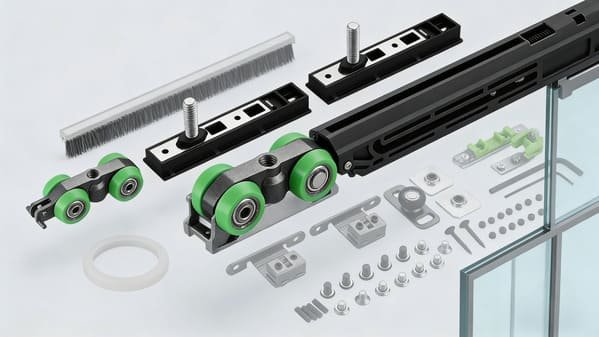
When we talk about a warranty for a glass sliding door pulley system, we are mainly talking about the parts that make it work. These are the core mechanical components that should last a long time if made correctly. However, some parts are designed to wear out over time with normal use. It is like the tires on a car; they are essential but not covered by the main car warranty for their entire life. You need to read the fine print in your contract. A good supplier will be transparent and provide a clear list. This prevents surprises later.
Understanding What’s Covered
Here is a common breakdown of what is usually included and what might not be.
Often Covered: These are parts that fail due to a mistake in manufacturing.
- Rollers (the wheels themselves)
- Bearing mechanisms
- The main metal track or rail
- Brackets and structural supports
Often Excluded: These are considered "consumable" parts or are subject to damage from outside factors.
| Component | Common Warranty Status | Reason for Exclusion |
|---|---|---|
| Rubber Gaskets/Strips | Excluded | Subject to wear, environmental exposure, and aging. |
| Brush Seals1 | Excluded | Designed to wear down over time with use. |
| Screws & Fasteners | Varies | Can be damaged by improper installation, not a defect. |
| Finish (Paint/Coating) | Varies | Can be damaged by harsh cleaning chemicals or scratches. |
The best way to be sure is to ask for a specific list. I always encourage my clients to do this. A clear understanding from the start builds a strong business relationship.
How do I claim a warranty if the hardware fails?
A part has failed, and your project is on hold. You are unsure how to start the warranty claim process, causing delays and frustration. You need a clear, simple procedure.
To claim a warranty, you must contact your supplier directly with proof of the failure. This usually includes your original purchase order, photos or videos of the defect, and a clear description of the problem. Follow the specific claim process outlined in your contract.

When a product fails, your first step should always be to contact the sales representative or support team you worked with. Do not try to fix or discard the part yourself before talking to them. At opensliding, we have a straightforward process to make it easy for our clients. We ask for evidence so we can understand what went wrong. This helps us not only solve your problem but also improve our products. A good supplier will want to investigate the failure. Remember, the process is defined in your contract. Look for the "Warranty Claim Procedure" section in the document.
A Step-by-Step Claim Guide
If you bought hardware from us or another Chinese supplier, the process will look something like this.
- Document the Issue: Take clear photos and videos showing the problem. If a roller is stuck, show it not moving. If a part is broken, show the break.
- Gather Your Information: Find your original invoice or purchase order number. Note the date of installation and the date the failure occurred.
- Contact Your Supplier2: Send an email or message with all the information you gathered. Be polite and clear. My email is evan@opensliding.com, and I am always ready to help my clients.
- Follow Instructions: The supplier will review your claim. They may ask for more information or for you to return the defective part for inspection. They will then tell you the next steps, like sending a replacement part.
| Action | Purpose |
|---|---|
| Provide PO Number | Helps the supplier find your order details quickly. |
| Send Photo/Video | Provides clear proof of the defect for quick assessment. |
| Describe the Problem | Explains how the failure impacts the door’s function. |
| Keep the Defective Part | The supplier may need it for quality control analysis. |
Are warranties transferable to end customers?
You sell to builders or homeowners, and they ask about the warranty. You are not sure if the factory warranty extends to them, which could hurt your sales and credibility.
Sometimes, but not automatically. The warranty you get from a B2B supplier like me is for you, the direct buyer. You must negotiate with your supplier if you want the warranty to be transferable to your end customers. This needs to be a specific clause in your contract.
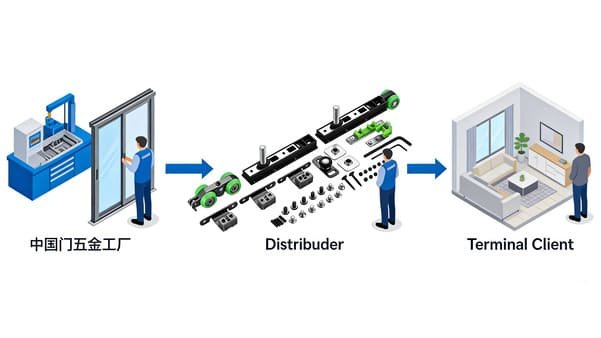
This is a very important point for distributors and contractors. The contract I have is with your company. Legally, my responsibility is to you. If your customer has a problem, they come to you, and you come to me. However, many of my clients use our factory warranty as a selling point. To support this, we can create an agreement that allows the warranty to be passed down. This is called a "transferable warranty." It helps you build trust with your customers. But it must be planned and written into our agreement. Never assume the warranty is transferable.
Making the Warranty Work for Your Business
A transferable warranty can be a powerful marketing tool. It shows that you and your supplier stand behind the product’s quality.
- Negotiate Transferability: When you are making a deal, tell the supplier you will be reselling the products and need a warranty that can be passed on to the final user.
- Create Your Own Warranty: Some of my clients offer their own warranty to their customers. They base it on our factory warranty but manage it themselves. This gives them more control.
- Provide Clear Documentation: Give your customers a clear warranty document3. It should explain what is covered, for how long, and how to make a claim through your company.
| Warranty Type | Who is Covered | Best For |
|---|---|---|
| Direct (Non-Transferable) | The company that buys from the factory. | Buyers who use parts in their own large projects. |
| Transferable | The direct buyer and the final end customer. | Distributors, contractors, and retailers. |
Discussing this with your supplier is key. As a partner, we want to help you succeed. If making the warranty transferable helps you sell more, we can find a way to make it work. The most direct way to get details is to contact your supplier.
Conclusion
In summary, the warranty for Chinese hardware is defined by your contract. Always clarify the term, coverage, claim process, and if it’s transferable before you buy.
Learn about the wear patterns of brush seals and how to manage them effectively to prolong their lifespan. ↩
Learning the best ways to communicate with suppliers can enhance your claim experience and ensure you receive timely assistance. ↩
A well-structured warranty document can prevent disputes and enhance customer satisfaction. ↩