
Confused by unlabeled hardware shipments? It leads to warehouse mix-ups and costly delays. Working with a supplier who provides clear labels solves this problem from the start.
Yes, most Chinese suppliers provide product labels for glass sliding door pulley systems. These labels typically include the brand and "Made in China." However, you must confirm specific details like compliance marks (e.g., CE) and custom branding directly with your supplier before ordering.
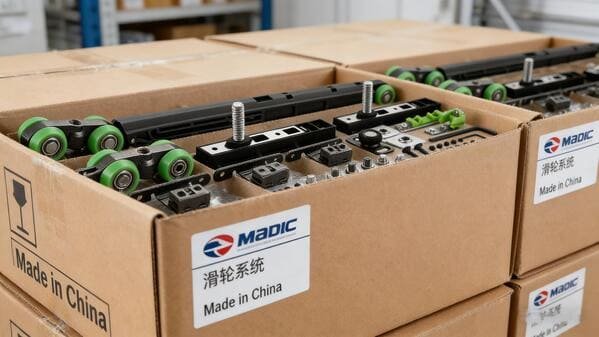
Getting a "yes" is a good start, but the details are what really matter for your business operations. Things like what goes on the label, where it’s placed, and language options are crucial. Let’s break down the common questions I get from clients like you.
Can labels include product specifications or model numbers?
Tired of your team grabbing the wrong part? This confusion leads to installation errors and delays. Including product specifications and model numbers on labels eliminates this guesswork completely.
Absolutely. You can and should request that labels include key product information. Most factories, like ours at opensliding, can easily add specifications, model numbers, dimensions, or material types. This is a standard part of customizing your order and helps ensure clarity for your team.
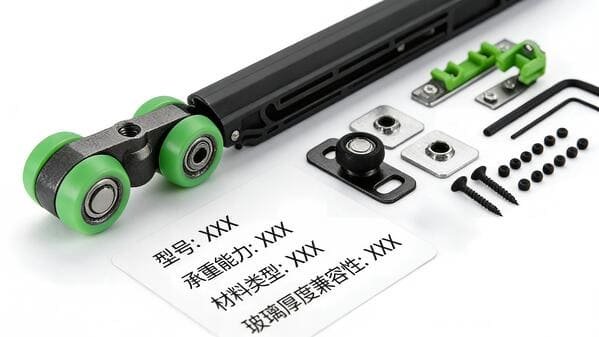
Including detailed information on your labels is not just possible, it’s a smart business practice. When you work with a factory supplier, customization is a key advantage. I always advise my clients to be very specific about what they need on their labels. Think about the journey of the product after it leaves my factory. Your warehouse staff needs to identify it, your sales team needs to reference it, and your installers need to confirm it’s the right part for the job.
Key Information to Request
Clear labels prevent costly mistakes. Here is a breakdown of what you can typically request:
- Model Number: The most critical piece of information for identification.
- Product Name: For example, "Heavy-Duty Glass Door Roller."
- Key Specifications1: Such as load capacity (e.g., 80kg), compatible glass thickness (e.g., 8-10mm), or material (e.g., SS304).
How to Communicate Your Needs
Provide your supplier with a clear template or a list of required fields. This avoids any misunderstanding. A simple table often works best:
| Field on Label | Example Content |
|---|---|
| Product Name | Glass Sliding Door Roller |
| Model No. | OSL-GDR-80A |
| Load Capacity | Max 80kg |
| Material | Stainless Steel 304 |
| For Glass | 8-10mm Thick |
This simple step makes your entire supply chain more efficient.
Are labels printed on each set or carton?
Receiving a huge carton with just one label? This forces your team to open boxes just to identify contents. Labeling individual sets or inner boxes streamlines your workflow significantly.
This depends on your agreement with the supplier. The standard practice is to label the outer master carton. However, you can request labeling on inner boxes or even individual product bags for a small fee. We do this often for our clients who are distributors.
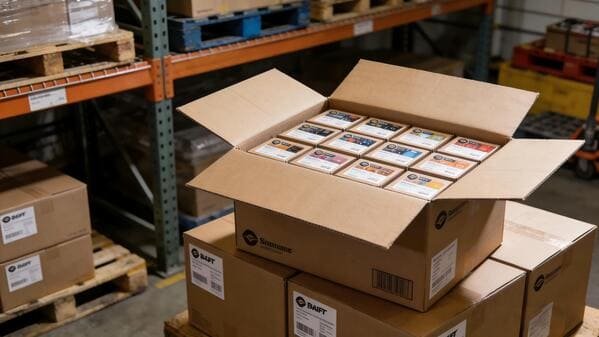
The level of labeling you need often depends on your business model. For a large construction contractor using a full carton of the same roller on a single project, one label on the master carton is usually enough. It keeps things simple. But for a distributor or a hardware store, the situation is completely different. You will be selling or distributing the hardware in smaller quantities, maybe even by the set. In this case, having labels on the inner boxes is essential. It allows your staff to quickly pick orders without opening every master carton. Some clients even require a small sticker with a barcode on each polybag containing a single roller set. This is the ultimate level of control for inventory management and point-of-sale systems. When you discuss your order with me or any supplier, be sure to specify your packaging hierarchy and where you need labels. Most factories are flexible and can meet your needs, though more detailed labeling might have a small impact on the final cost.
Can I request multilingual labels?
Selling to diverse markets? English-only labels can confuse your international customers or non-English speaking staff. This can lead to incorrect use or ordering, hurting your brand’s reputation.
Yes, requesting multilingual labels is a common and highly recommended practice for international businesses. As a factory, we can print labels in multiple languages, such as English, Spanish, French, or Russian, based on the text you provide. This helps you cater to different markets effectively.

In my experience working with buyers from all over the world, multilingual labels are a game-changer. For example, I have a client in Canada who needs labels in both English and French to comply with national regulations and serve their customer base. Another client in the UAE requests English and Arabic. Providing these labels is a straightforward process. You simply need to give us the exact translated text for each field you want on the label. We will then create a proof for your approval before mass production begins.
Why This Matters for Your Business
- Market Compliance2: Some countries have legal requirements for products to be labeled in the local language.
- User Experience3: It makes the product more accessible and user-friendly for a wider audience, from warehouse workers to end-users.
- Brand Professionalism: It shows that your brand is thoughtful and professional, catering to the specific needs of each market you enter.
Before placing your order, research the labeling laws in your target countries. Then, send your supplier a finalized document with all the necessary translations. It’s a simple step that adds huge value.
How do labels help with inventory management?
Struggling with slow, manual inventory counts? Inaccurate stock levels lead to ordering too much or too little, hurting your cash flow and causing stockouts that disappoint customers.
Proper labels, especially those with barcodes or QR codes, are the backbone of modern inventory management. They allow for fast, accurate scanning, which automates tracking, reduces human error, and gives you real-time data on your stock levels. This is crucial for efficiency and profitability.
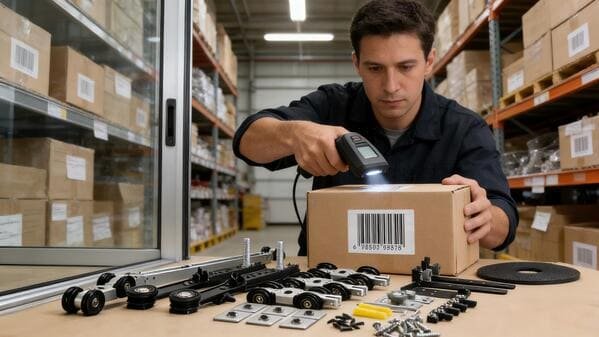
I’ve seen firsthand how a simple label can transform a client’s warehouse operations. Before, they were counting boxes by hand, using spreadsheets, and often making mistakes. After we started adding barcodes to their labels, everything changed. Their receiving process became faster; instead of manually checking a packing list, they just scan the cartons. Picking orders for their customers became more accurate because the scanner confirms they have the right model number. And their inventory counts, which used to take days, can now be done in hours. This efficiency directly impacts your bottom line.
Key Benefits of Labeled Inventory
This system moves you from guessing to knowing.
- Speed: Scanning is exponentially faster than manual entry.
- Accuracy: It eliminates human error in data recording.
- Real-time Data4: You know exactly what you have in stock at any moment.
Implementing a Barcode System
| Step | Action |
|---|---|
| 1. Choose a Format | Decide on a barcode type5 (e.g., UPC, EAN, or a simple Code 128). |
| 2. Assign Codes | Give each unique product model its own barcode number. |
| 3. Inform Supplier | Provide your supplier (like me at opensliding) with the list of codes. |
| 4. Integrate | Use a scanner and inventory management software to track the scanned data. |
By asking your supplier to add barcodes, you are investing in a more streamlined, accurate, and profitable business.
Conclusion
In summary, Chinese suppliers can provide detailed, multilingual labels on cartons or individual sets. This simple customization is key to improving your inventory management and operational efficiency.
Exploring Key Specifications will guide you in making informed decisions, ensuring the products meet your specific needs. ↩
Understanding market compliance is crucial for avoiding legal issues and ensuring your products meet local regulations. ↩
Enhancing user experience through effective labeling can significantly improve customer satisfaction and brand loyalty. ↩
Exploring this link will help you understand how real-time data can enhance your inventory accuracy and efficiency. ↩
This resource will provide insights into various barcode types, helping you choose the best one for your inventory system. ↩